

This week Robert Hall of Stanford University and Michael Woodford of Colombia won the Sveriges Riksbank Prize in Economic Sciences in Memory of Alfred Nobel.* They’re supposed to have developed new macroeconomic models that help governments flatten out peaks and troughs using tax, spending and interest rates.
Of the 101 recipients since 1969, they’re the 74th and 75th to come from the United States. 76% of prizewinners did their PhDs in the US and 84% worked there.
Precisely four winners or co-winners have been from the global South - India’s Amartya Sen and Abhijit Banerjee; St Lucia’s Arthur Lewis; and Daron Acemoglu from Turkey (Türkiye), who teaches at MIT.
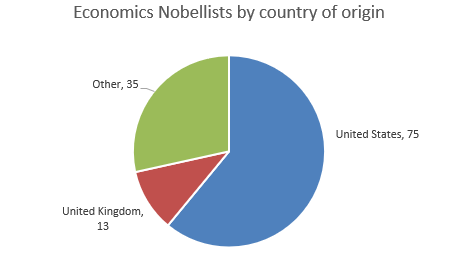
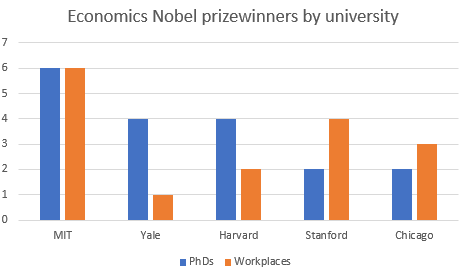
The prize is dominated by Americans, who’ve won the prize every year for the past decade. Five universities dominated the period: MIT, Yale, Harvard, Stanford and Chicago. As Robin Wigglesworth says in FT Alphaville, "You don’t have to be American and affiliated with MIT to win an economics Nobel — but it helps!"
Other Nobel disciplines are far more geographically dispersed. During the same period 61% of Nobel laureates in Medicine/Life Sciences were based in the US, 54% in Chemistry and 48% in Physics. Literature and peace prizes are dominated by Europe.
Of course it just might be that economics is an objective science whose practitioners and theorists flock to the US because unlike other fields it happens to have perfected the discipline. Other institutions and countries might not be up to scratch.
Dressing up as science
I doubt it, though. I think it’s much more to do with ideology and economic interests. In 1985 Hall, who also works at the Hoover Institution, co-wrote a book called The Flat Tax, which argued that rich people shouldn’t pay higher taxes than labour - one of the major arguments of Reaganomics. A flat tax was supposed to be “less distortionary,” according to the Wall Street Journal’s review.
In reality it would mean poorer people paying a higher proportion of their income than the rich and thus violate the principle of progressivity that is central to modern taxation. Ideas like the flat tax occasionally rear their heads but are dismissed as ideological and unworkable.
Michael Hudson further points out that Hall worked for thirty years at the National Bureau of Economic Research, whose doctrine is that business downturns correct themselves thanks to “market adjustments” that are “automatic stabilizers.” One of the main points of Hall and Woodford’s research is that governments don’t, in fact, have to intervene heavily to smooth economies and can instead affect outcomes through public discourse.
Woodford said his work aimed to make clear that policy should not simply be about “pulling levers to control the economy” but should allow governments “to talk to the public about what they are doing”.
The political implications of this research are clear. It’s a hands-off, Friedmanite, anti-interventionist stance which fits closely with the neoliberal right. Rather than objective science like chemistry, physics or biology, it’s a contested view.
Out of the 101 economics laureates, only two can be described as heterodox — in 1974 Gunnar Myrdal and arguably Friedrich Hayek. Herbert Simon in 1978 and Elinor Orstrom in 2009 might also qualify, but this is open to dispute.
More likely, North American universities with free-market propensities, particularly the big five, have developed a syllabus that cover what they consider to be economics, in effect capturing the Nobel because they’ve defined the discipline and by definition excluded outsiders. A particular type of mainstream neoclassical economics — concerned with utility-maximisation, a narrow conception of rationality and individualism — has come to dominate the prize and excluded other types of economics.
What if biologists researched only flowers, or physicists only outer space?
It’s not only the Nobel that’s become American; mainstream economics journal articles focus overwhelmingly on the US.
In a well-known article from just over a decade ago, a sample of 76,000 papers published between 1985 and 2005 showed that were more papers about the US than on Europe, Asia, Latin America, the Middle East and Africa combined.
Academic economists almost totally ignore the poorest countries. In the 20 years concerned, only four papers were written about Burundi. The imbalance is even more marked for the top five economics journals. The American Economic Review, the fulcrum of academic desire, published one paper on India every two years.
Economics isn’t like physics or chemistry. An atom is an atom. A sub-atomic particle is a sub-atomic particle. Economics is inherently social and variegated, and people behave differently across time and place. Working on only a tiny fraction of the economic world is just as ridiculous if biologists researched only flowers, or physicists only outer space.
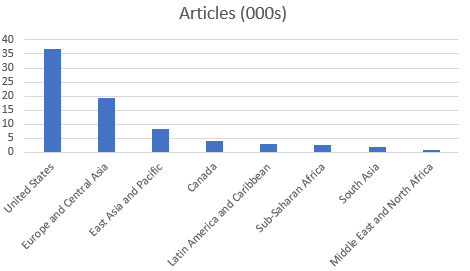
Other papers published since confirm similar biases. “The distribution of economic research across countries is strikingly unequal” finds this article from last year. This paper from 2021 finds that the editorial power of over half of top economics journals is mostly located in the USA. Most editorial teams are less geographically diverse and more North American than the authors they publish.
The Economist newspaper explained the American bias of economics partly by saying that reams of data exists on America so it’s easier to crunch the numbers. Poorer countries are less well enumerated. But that’s like saying oceanographers should ignore the deep ocean because they haven’t been able to explore it yet. The deep sea is considered one of the last frontiers and scientists are doing all they can to understand it better.
The Economist cites another explanation for economists’ bias toward the States: that the intellectual kudos in solving a problem about the American economy is much higher than understanding a less developed country.
But if economists are so career-obsessed that they’ll ignore the rest of the world, then this further confirms that they’re doing ideology, not science. Understanding countries and people should be much more important than the formal games of self-advancement played out in the supposedly top journals.
It’s ludicrous to suggest that if something isn’t yet a statistical dataset or wins less acclaim then it isn’t worthy of study. We wouldn’t be able to do or say anything about economic policy in most of the world because the numbers are ropy or don’t exist yet. But policymakers can and do conduct policy all the time, using whatever tools they have to hand.
Just because lower-income countries aren’t bulging with reams of data shouldn’t make them invisible. Requiring economists only to use supposedly hard stats built by statistics agencies in effect amounts to the wielding of power. ‘We’ western academics will develop techniques which frame the debate because they only ask certain questions, and then we’ll analyse these issues to death without considering things that people in poor countries might care about. Economics thus becomes by definition the study of rich countries.
Research techniques and modes of analysis exist which can capture subjective information, and local knowledge can be uncovered if you look for it. As (yes, American Nobel prizewinning economist) Paul Krugman has said, some of the best economics happens on blogs, in working papers and in online publications.
Anthropologists have long studied societies using written fieldwork compiled over years of immersion in the community. Modern techniques can overcome the old shortcomings of data collection.
To cite one recent example: former World Bank economist Vijayendra Rao found that mainstream economics’ standard toolkits, like quantitative surveys and randomized controlled trials, distance researchers from the actual lives of the people they study. As he notes, “Almost everyone I know who studies poverty has never been poor”.
Economists don’t ask the right questions: Because they’re so detached, they often fail to grasp local context, history, and social dynamics, meaning they run the risk of asking the wrong questions or treating rich human context as mere “noise”.
Rao argues for incorporating slow, careful ethnographic and qualitative methods from anthropology. Spending real time listening to communities produces insights that numbers alone cannot capture.
Rao argues that mixed methods including machine learning and natural language processing have huge potential over econometric techniques, as long as they are used sensitively.
Delve around in more places
Many economists appear to think that if they hone their techniques in the US laboratory, then they don’t need to look further afield. But the US isn’t a laboratory; it’s a small corner of the world, albeit a powerful one where things work in a peculiar way.
So for economists to focus only on America is as partial as if biology confined itself to floriculture, or as if physicists gazed only at the heavens, and omitted the vast and fascinating research space that exists in the rest of the world. We’d be outraged if any other science was so blinkered. Why not with economics?
The Economist says that: “the world’s poorest countries would benefit from having more economists poking around. With more published research, it would be easier for those countries to base policies on hard evidence, rather than on politicians’ whims. Economists ought to be bolder in venturing outside their comfort zone.”
I half-agree, in that the dominant academic institutions should hugely rebalance their research in favour of practical, empirical research on the rest of the world as it actually exists. But at the same time without a major overhaul of the techniques and methods of economics I’m not sure I want mainstream economists to poke around more in poor countries because they might make just as much a mess of things as they have in the rich world.
*The Economics Nobel isn’t really a ‘Nobel prize’ - it was launched by the Riksbank in 1968. The word ‘Memorial’ was explicitly added in commemoration of Alfred Nobel, who wrote “I hate business with all my heart”. His descendants, including his great-grandnephew Peter Nobel, have publicly said that they don’t approve of the economics prize. The family has argued that Alfred “despised people who cared more about profits than society’s well-being” and that using his name for a commercial/financial discipline is a “PR coup” that violates his humanitarian legacy.
This narrow focus is no mystery. Neoliberal economics is the continuation of colonialism providing a thinly veiled excuse for powerful countries to go on extracting and accumulating wealth from weaker ones. Validating the ‘theory’ has to be restricted to the global north where there the charade can be safely protected.
Look forward to more on your contribution to pulling back the veil!
I struggle to understand why so much attention is paid to the predictions of economists. For example, Solow’s Residual. How could a theory last which could only explain some 13% of the issue being examined? It took decades before the addition of energy, or more precisely, exergy closed the gap.